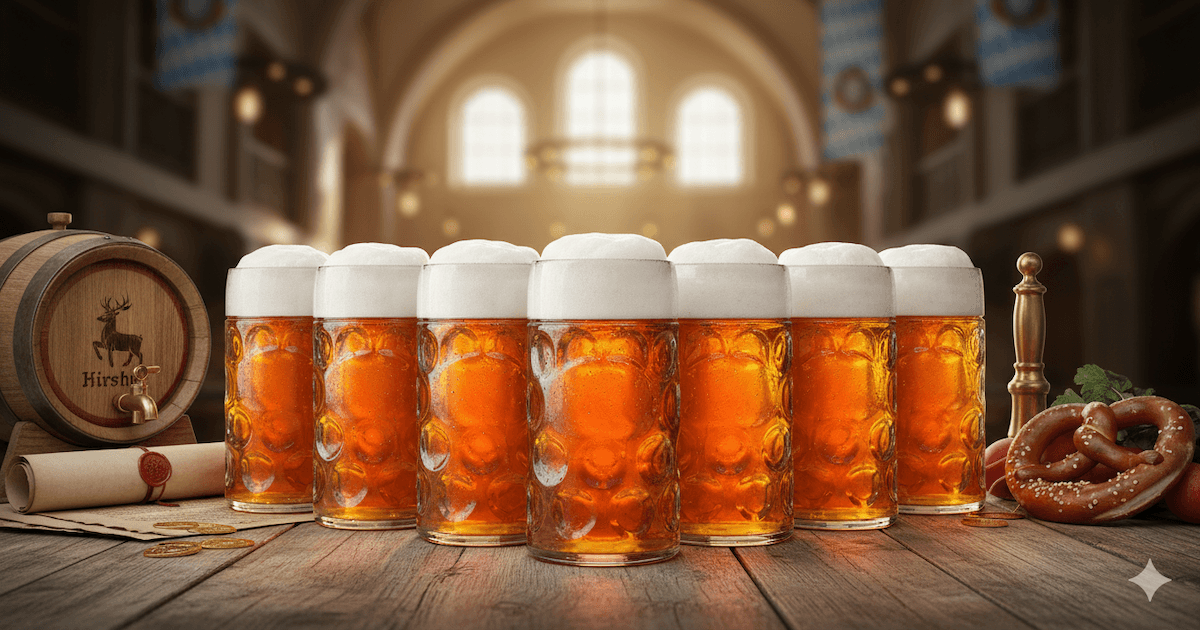
When you raise a Mass at Oktoberfest, you're not just drinking any beer—you're sipping from a tradition protected by some of the strictest brewing rules in the world. Only six Munich breweries have the exclusive right to serve their beer at the world's largest folk festival, and they've maintained this monopoly for over a century. But what makes these breweries so special, and why is a seventh brewery now challenging their reign?
The Sacred Rules of Oktoberfest Beer
Before diving into the breweries themselves, it's important to understand the rules that govern Oktoberfest beer. Two strict requirements must be met for any beer served at the festival.
First, the beer must comply with the Reinheitsgebot, Germany's famous Beer Purity Law enacted in 1516. This ancient regulation, one of the oldest consumer protection laws still in effect, mandates that beer can only be brewed using four ingredients: water, malted barley, hops, and yeast. For Oktoberfest specifically, the beer must have a minimum of 13.5% Stammwürze, which translates to approximately 6% alcohol by volume.
Second, and perhaps more controversially, the beer must be brewed within Munich's city limits using water from Munich's deep wells. This geographical requirement has effectively created a brewing monopoly that has remained unchanged for generations. According to a 1990 ruling by the Munich Regional Court, Oktoberfest is officially considered the "Festival of Munich Beer," cementing these restrictions into law.
These rules have ensured that only six breweries—Augustiner, Hacker-Pschorr, Hofbräu, Löwenbräu, Paulaner, and Spaten—can pour their golden nectar in the festival tents.
Augustiner-Bräu: Munich's Oldest Brewery
Founded in 1328 by Augustinian monks at their monastery on the Haberfeld outside Munich's city walls, Augustiner holds the distinction of being the oldest brewery still operating within Munich's city limits. For nearly 500 years, the monks brewed their beer within the monastery, even serving as the official beer supplier to the Bavarian Royal Wittelsbach family until 1589.
During the secularization movement of 1803, the monastery was dissolved, and the brewery passed first into state hands and then into private ownership. In 1817, the brewery relocated to Neuhauser Straße, where the beloved Augustiner restaurant still stands today. By 1829, Anton and Therese Wagner, a seasoned brewing couple, acquired the brewery, and it has remained privately owned by their descendants ever since.
What truly sets Augustiner apart is its commitment to tradition. It's the only Munich brewery that still uses traditional 200-liter wooden barrels, called Hirschen, for storage. This dedication to old-world methods has earned Augustiner a cult following among Munich locals, who often consider it the finest beer in the city. At Oktoberfest, you can find the 6.3% Augustiner Wiesnbier in the Augustiner Festzelt and Fischer Vroni, where it's poured directly from those iconic wooden barrels.
Hofbräu München: The Royal Court Brewery
In 1589, Duke Wilhelm V of Bavaria grew so dissatisfied with Munich's beer that he commissioned his own state brewery to supply his court of 600 nobles and servants. Thus, the Staatliches Hofbräuhaus was born, with its first brewmaster, Heimeran Pongratz, setting up operations at the Alten Hof.
The brewery's success quickly outpaced its capacity, and in 1607, Duke Wilhelm's son Maximilian I built a new, larger brewery on the Platzl—the site where the world-famous Hofbräuhaus beer hall still stands today. For centuries, Hofbräu beer was reserved exclusively for the royal court, but in 1828, King Ludwig I issued a decree opening the Hofbräuhaus to the general public, much to the dismay of Munich's private brewers who feared the competition.
Today, Hofbräu operates as a state-owned enterprise, and its brewing facilities are located in Munich-Riem. The brewery's beer is particularly popular with international visitors at Oktoberfest. At 6.3% alcohol content, Hofbräu Oktoberfest is one of the strongest Wiesn beers and is served exclusively in the massive Hofbräu Festzelt.
Paulaner: Born from Monastic Devotion
Paulaner's story begins in 1634 when monks from the Paulaner Order at the Neudeck ob der Au monastery began brewing a strong beer called Salvator. They followed the Reinheitsgebot strictly, and whatever they didn't consume themselves was given to the poor or sold in the monastery tavern. The beer became so popular that Munich's civilian brewers complained to the city council about the competition—this complaint is considered the first documented evidence of Paulaner Brewery and marks its official founding date.
A turning point came in 1773 when a monk named Valentin Stephan Still, known as Brother Barnabas, arrived at the monastery. His innovative brewing techniques revolutionized the beer's quality, and his recipe still forms the basis for today's Paulaner Salvator. After secularization, the brewery passed into private hands and began its commercial expansion.
For generations, Paulaner's headquarters was located at the Giesinger Nockherberg, the site of Munich's famous annual Starkbierfest (Strong Beer Festival). Today, the brewery operates from Munich-Langwied. At Oktoberfest, Paulaner's 6% beer is served in multiple tents, including the Paulaner Festzelt, Armbrustschützenzelt, and Käferzelt, among others.
Hacker-Pschorr: A Love Story Turned Empire
The Hacker brewery was first mentioned in documents in 1417, making it nearly a century older than the Reinheitsgebot itself. Originally located at what is now the Altes Hackerhaus on Sendlinger Straße, the brewery developed a reputation for quality beer over the centuries.
The brewery's modern identity emerged from a romantic union. In the late 18th century, Joseph Pschorr married Maria Theresia Hacker, daughter of the brewery's owner. Together, they transformed Hacker-Pschorr into one of Munich's leading breweries. In 1813, they constructed Germany's largest storage cellar in Landsberger Straße—a massive "beer fortress" spanning 4,000 square meters with storage for over 35,000 hectoliters.
When Joseph Pschorr died, his two sons divided the business, running Hacker and Pschorr as separate breweries for over a century. The two companies finally reunited in 1972 to form the modern Hacker-Pschorr. In 2007, Hacker-Pschorr became the first Munich brewery to reintroduce traditional swing-top bottles with their distinctive "Plopp" sound.
At Oktoberfest, Hacker-Pschorr's 6% beer is served in the Hacker Festzelt and Bräurosl, where you can also find the original amber-colored Wiesnmärzen poured from wooden barrels.
Löwenbräu: The Lion's Brew
Löwenbräu—literally "Lion's Brew"—takes its name from its original location at 17 Löwengrube (Lion's Pit), where a 17th-century fresco depicted Daniel in the lions' den. While the brewery claims origins around 1383, the first documented evidence of a brewer at that location dates to 1524, when Jörg Schnaitter appears in Munich's tax records. The name Löwenbräu itself didn't appear in official brewery registers until 1746.
The brewery's transformation into a powerhouse began in 1818 when Georg Brey, a brewer of peasant origins, purchased it. Under his management, Löwenbräu grew rapidly, and by 1863, it had become Munich's largest brewery, producing a quarter of the city's beer. The brewery's iconic lion logo was officially trademarked in 1886, and by the turn of the century, Löwenbräu was the largest brewery in all of Germany.
The grand Löwenbräukeller, designed by the Rank brothers, opened in 1883 and remains one of Munich's most beloved beer halls. At Oktoberfest, you can't miss the Löwenbräu tent—it's the one with the gigantic mechanical roaring lion perched on top. The 6.1% Löwenbräu Oktoberfest beer is served in both the Löwenbräu-Festhalle and Schützenfestzelt.
Spaten-Franziskaner-Bräu: The Innovator
Spaten's history stretches back to 1397, when a brewer named Hans Welser operated the Welser Prew on Neuhausergasse. The brewery changed hands multiple times until the Spatt family acquired it in 1622, giving it the name "Spaten" (spade), which refers to a brewer's malt shovel.
The brewery's golden age began in 1807 when Gabriel Sedlmayr, the royal court's brewmaster, purchased what was then Munich's smallest brewery. Under the Sedlmayr family—arguably Munich's most prestigious brewing dynasty—Spaten became a powerhouse of innovation. Gabriel Sedlmayr the Younger traveled throughout Europe studying brewing techniques, and in 1844, he introduced steam power to the brewery. By 1861, Spaten had grown to become Munich's largest brewery, a position it maintained until the 1890s.
Spaten pioneered many brewing innovations, including the introduction of Märzenbier in 1841 and Munich's first Münchner Hell (pale lager) in 1894. The brewery's significance in lager brewing history cannot be overstated—beer historian Michael Jackson called Spaten "the most significant brewery in the history of lager beer."
At Oktoberfest, Spaten holds a special honor: each year, the festival officially begins when Munich's mayor taps the first keg in the Schottenhamel tent, and that keg is always Spaten. The brewery's Oktoberfest beer is served in multiple tents across the festival grounds.
The Challenger: Giesinger Bräu
While technically not one of the six official Oktoberfest breweries, Giesinger Bräu has become impossible to ignore in any discussion about Munich brewing. Founded in 2005 as a garage project by Steffen Marx, Giesinger has grown from a tiny operation into a serious contender that's challenging the century-old Oktoberfest monopoly.
For years, Giesinger faced a critical obstacle: to be considered an official Munich brewery, beer must be brewed with water from Munich's deep wells, not the city's tap water (which comes from the Mangfall region). In 2020, Giesinger invested €1 million to drill a 152-meter-deep well at their new brewery location in Munich's northern suburb of Lerchenau. This expensive gesture officially qualified Giesinger as the seventh Munich brewery.
But drilling a well doesn't automatically grant access to Oktoberfest. The festival's tent allocations haven't changed in over a century, and getting a spot would require either owning a tent (which Marx estimates would take 50 years) or convincing one of the existing tents to switch suppliers—a move that would require approval from Munich's city council.
Giesinger's quest has ignited controversy. In 2025, Marx publicly accused Hacker-Pschorr of using tap water instead of deep well water for their Oktoberfest beer, a claim Hacker-Pschorr vehemently denied. The dispute highlights the tensions surrounding the exclusive nature of Oktoberfest brewing rights, with some viewing it as protecting tradition and others seeing it as an unfair monopoly.
Marx remains optimistic, stating he plans to have Giesinger beer served at Oktoberfest within three to five years. Whether this upstart brewery can break into the world's most exclusive beer festival remains to be seen, but Giesinger's story adds an fascinating modern chapter to Munich's centuries-old brewing tradition.
Why These Six Matter
Each of Munich's six official Oktoberfest breweries brings centuries of history, innovation, and tradition to the festival. From Augustiner's 700-year legacy and wooden barrels to Spaten's pioneering spirit and Hofbräu's royal heritage, these breweries represent more than just beer—they're living institutions that have shaped Bavarian culture.
The strict rules governing Oktoberfest beer ensure quality and preserve tradition, but they also create a closed system that some argue stifles competition and innovation. As Giesinger's challenge demonstrates, the question of who gets to pour beer at the world's largest folk festival isn't just about brewing—it's about tradition, economics, and the evolving identity of Munich itself.
Whether you're a first-time visitor or a seasoned Oktoberfest veteran, understanding the breweries behind your Mass adds depth to every sip. These six breweries have earned their place at Oktoberfest through centuries of dedication to their craft, and their beers remain the gold standard by which all other festival beers are measured.