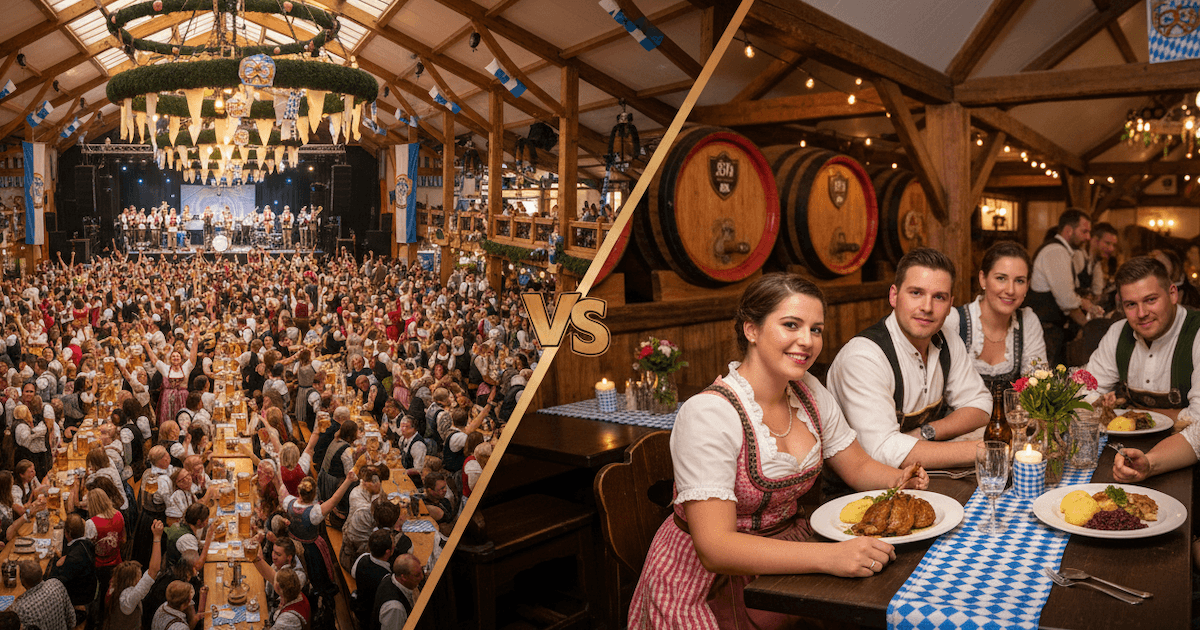
One of the most important decisions you'll make when planning your Oktoberfest visit is choosing which tent to experience. With 14 large tents and 21 small tents scattered across the Theresienwiese, each offering a distinct atmosphere, the choice can feel overwhelming. Should you dive into the legendary party atmosphere of a massive 10,000-person beer hall, or seek out the cozy charm of a 400-seat local hideaway?
The truth is, large and small tents offer fundamentally different experiences. Understanding these differences will help you choose the right fit for your group, timing, and expectations. Let's break down everything you need to know about both options.
What Defines Large vs Small Tents?
Before diving into pros and cons, it's important to understand what distinguishes these two categories at Oktoberfest.
Large tents are the festival's iconic beer halls, accommodating between 3,000 and 10,000 guests. The Hofbräu Festzelt holds the crown as the largest, with space for 10,040 people including 6,898 indoor seats, 1,000 standing places, and 3,022 beer garden seats. Most large tents feature around 6,000 indoor seats divided between the central aisle, side boxes, and balconies, plus expansive outdoor beer gardens.
Small tents are a different beast entirely, with capacities ranging from just 100 to 1,000 guests combined between indoor and outdoor seating. These intimate venues often specialize in specific cuisines—from fish and wild game to organic poultry and vegetarian options—and cater primarily to local Munich residents rather than international tourists.
Large Tents: The Pros
The Epic Party Atmosphere
When you picture Oktoberfest, you're almost certainly imagining a large tent. This is where the legendary party happens. From 10 AM when the tents open until 11:30 PM closing time, live brass bands blast traditional Bavarian music interspersed with international party hits. Thousands of revelers dance on benches, sway their beer steins in unison during "Ein Prosit," and create an electric energy that's simply impossible to replicate on a smaller scale.
The sheer scale amplifies everything. When the band strikes up "Country Roads" or "Hey Baby" and 6,000 people sing along, it's a spine-tingling experience you won't forget. This is Oktoberfest at its most jubilant, chaotic, and unforgettable.
Better Chances of Getting In Without a Reservation
Here's a crucial advantage: Munich law requires large tents to keep substantial portions unreserved for walk-in guests. Specifically, 25% of all indoor seats must remain unreserved on regular days, and that increases to 35% on Saturdays, Sundays, and holidays before 3 PM, jumping to 50% of all seats during those peak times.
This means even without a reservation, you have a legitimate shot at finding seats, especially if you arrive on weekday mornings or early afternoons. Small tents, by contrast, are exempt from these regulations and can reserve their entire capacity.
Standing Room Options
The Hofbräu Festzelt offers something unique among Oktoberfest tents: a standing-room-only area accommodating nearly 1,000 guests right in front of the stage. This "Stehbereich" is perfect for those who can't find seats but still want to be in the action. You can order beer, soak up the atmosphere, and enjoy the party even when every seat is taken. No other tent offers this flexibility.
Diverse Crowds and International Vibe
Large tents attract visitors from around the globe. You'll find yourself clinking steins with Australians, Italians, Americans, Japanese tourists, and locals alike. This international mix creates a vibrant, welcoming atmosphere where everyone's united by beer and celebration. If you're traveling solo or with a small group and enjoy meeting new people, the large tents provide countless opportunities for spontaneous friendships.
Multiple Beer Garden Spaces
Most large tents feature expansive outdoor beer gardens that remain almost entirely unreserved. These gardens offer a breather from the intensity inside—fresh air, natural light, and a slightly calmer atmosphere while still being part of the action. On a warm September afternoon, there's nothing quite like enjoying your Mass in a sun-dappled beer garden surrounded by thousands of happy festivalgoers.
Large Tents: The Cons
Overwhelming Crowds and Chaos
The very thing that makes large tents exciting can also be exhausting. With up to 10,000 people packed into a single space, things get crowded, loud, and sometimes overwhelming. Navigating to the bathroom requires strategic planning and patience. Finding your friends after they wander off can feel like a search-and-rescue mission. The sensory overload—constant noise, bodies pressing in from all sides, beer sloshing everywhere—isn't for everyone.
On Friday evenings and Saturdays, tents regularly close their doors due to overcrowding, turning away everyone without reservations or wristbands. Even with a reservation, entering during peak times can involve long waits and security checks.
Difficulty Getting Seats During Peak Times
Despite the reserved section regulations, finding seats without a reservation during evening hours or weekends remains challenging. On Saturdays, people line up before 9 AM—hours before the grounds officially open—just to secure unreserved spots. The reservation changeover around 5 PM is particularly chaotic, with some tents temporarily closing their doors entirely during this transition.
If you're visiting with a large group, your chances of finding adjacent seats without a reservation are slim. Groups of six or more should seriously consider booking ahead for evening visits.
Less Authentic, More Touristy
While international crowds bring energy, they also dilute the traditional Bavarian atmosphere. Large tents, particularly Hofbräu, are notorious for catering heavily to tourists. You're more likely to encounter drunk revelers on stag parties than families in traditional dirndls and lederhosen. The music shifts toward crowd-pleasing international hits rather than authentic Bavarian folk songs.
If you're seeking genuine Bavarian culture rather than a massive party, the large tents might disappoint.
Service Can Be Slow
With thousands of guests to serve, getting a server's attention in a large tent requires patience and persistence. During peak hours, you might wait 20-30 minutes between ordering and receiving your beer. The servers, while remarkably efficient considering the chaos, are stretched thin. They'll prioritize reserved tables and regulars over walk-in guests, so be prepared to wait.
Beer First, Food Second
The culinary focus in large tents is decidedly secondary to beer consumption. While the food is generally good—classic offerings like hendl, schweinshaxe, and pretzels—it's not particularly special or innovative. The menus are standardized, portions are huge but unremarkable, and presentation is utilitarian. If you're a foodie looking for culinary excellence, you'll be disappointed.
Small Tents: The Pros
Intimate, Authentic Atmosphere
Small tents offer what many consider the "real" Oktoberfest experience. These cozy spaces, holding just a few hundred guests, maintain a neighborhood feel where locals gather year after year. You'll find Munich families with children during the day, older couples dancing traditional Bavarian waltzes, and regular patrons who've been coming to the same tent for decades.
The atmosphere is warm and welcoming rather than overwhelming. Conversations are possible without shouting. You can actually hear the live band's nuances rather than just a wall of sound. Many visitors report that their most memorable Oktoberfest moments happened in small tents where they felt like honored guests rather than anonymous tourists.
Exceptional, Specialized Cuisine
This is where small tents truly shine. Rather than generic beer hall fare, small tents specialize in specific culinary niches. Fisch-Bäda serves over 20 different fish dishes from responsibly sourced seafood. Ammer and Poschner's roast organic chicken and duck to perfection. Münchner Knödelei specializes in traditional Bavarian dumplings. Café Kaiserschmarrn offers homemade cakes and pastries in a cozy café atmosphere.
The philosophy here is "food first, beer second"—the opposite of large tents. Dishes are prepared with care, ingredients are often organic or locally sourced, and presentation matters. Many small tents have won awards for their cuisine. If you're a food lover, the small tents are mandatory stops.
Easier to Find Seats (Sometimes)
This is counterintuitive but true: while small tents can reserve their entire capacity and don't have the mandatory unreserved sections of large tents, they're also less crowded overall. During weekday afternoons and early evenings, you'll often find open tables at small tents even when large tents are bursting at the seams.
The secret is that most tourists don't even know the small tents exist. They beeline for the famous large tents and miss these hidden gems entirely. Solo travelers and couples often have better luck in small tents than fighting for space in the massive halls.
Family-Friendly Environment
Many small tents are genuinely welcoming to families with children. They offer kids' menus with fun coloring activities, stroller-friendly access, and children's meals. The daytime atmosphere is calm and appropriate for all ages, with none of the drunken rowdiness that can make large tents uncomfortable for families.
Ammer, Fisch-Bäda, and Poschner's are particularly known for their family-oriented atmosphere during daytime hours. Parents can actually relax and enjoy themselves rather than constantly worrying about the chaos around them.
Traditional Music and Entertainment
Small tents often feature some of Oktoberfest's most traditional entertainment. Instead of blasting international pop hits, you'll hear authentic Bavarian brass bands, folk singers, and traditional Schuhplattler dancers. Many small tents bring in whipcrackers—performers who crack whips in rhythm with the music, a mesmerizing traditional Bavarian art form.
The musicians' tents on the Oide Wiesn are dedicated entirely to preserving traditional Bavarian music. If cultural authenticity matters to you, small tents deliver in spades.
Beer Gardens Without the Madness
Small tent beer gardens offer all the charm of outdoor drinking without the overwhelming crowds. These spaces maintain an intimate feel, often with quirky features like revolving bars, alpine hut designs, or historic bowling alleys. You can actually have a conversation, enjoy the September weather, and feel like you're at a beloved neighborhood gathering rather than a massive tourist event.
Small Tents: The Cons
Limited Capacity Means Fewer Opportunities
The flip side of intimacy is exclusivity. With only 100-1,000 total seats, small tents fill up quickly. Once they're full, you're out of luck—there's no standing room option like at Hofbräu. If you arrive at peak times without a reservation, you might not get in at all.
Some small tents, like Fischer-Vroni, rarely release public reservations and cater primarily to longtime regulars. Breaking into these tight-knit communities as a first-time visitor can be challenging.
Less Party Energy
If you're coming to Oktoberfest for the legendary party atmosphere—dancing on benches, massive singalongs, wild energy—small tents will disappoint. While they transform into livelier spaces in the evening, they never reach the fever pitch of large tents. There's no dancing on benches, no standing-room mosh pit, no spine-tingling moment when 6,000 people sing in unison.
The atmosphere is lovely if you want cozy and traditional, but it's not what most people picture when they imagine Oktoberfest.
Harder to Find Without Local Knowledge
Many small tents are tucked away in corners of the festival grounds, unmarked and easy to miss. They don't have the massive presence and signage of large tents. Tourists often walk right past them without realizing they're there. Finding specific small tents requires research, maps, and sometimes asking locals for directions.
Higher Minimum Consumption for Reservations
While large tents require vouchers worth around €45 per person for reservations, small tents can charge significantly more. The regulations allow small tents to require €50 per person for reservations before 2 PM, and €75 per person after 2 PM and on weekends. This makes reserving tables at small tents considerably more expensive, especially if you're just interested in the atmosphere rather than a full meal.
Mostly Locals, Potentially Less Welcoming
Small tents cater overwhelmingly to Munich locals, many of whom return to the same spot year after year. While most guests are friendly, you might occasionally encounter cliquish behavior or feel like an outsider. Some regular patrons are protective of "their" tents and less enthusiastic about the tourist influx.
This isn't universal—many visitors report wonderful experiences at small tents—but the international, everyone-welcome vibe of large tents is more guaranteed.
Closes Earlier for Overcrowding
Because of their limited capacity, small tents can hit capacity and close their doors even earlier than large tents. On busy days, this might happen by mid-afternoon. Once closed, there's no getting in, no standing room exceptions, and no alternatives except trying another tent.
The Oide Wiesn: A Special Middle Ground
Worth mentioning separately is the Oide Wiesn, the "Old Oktoberfest" area that's been part of the festival since 2010. This special section requires a €4 admission fee and offers a more traditional, nostalgic Oktoberfest experience.
The Festzelt Tradition is the largest tent here, with 5,000 indoor and 3,050 outdoor seats. It delivers authentic Bavarian tradition—brass bands, whipcrackers, folk dancers, and beer served from stone mugs filled from wooden barrels. There's no dancing on benches, but there is a designated dance floor where guests perform traditional Bavarian dances.
The Oide Wiesn offers a compromise: larger capacity than small tents but more traditional atmosphere than the main festival's large tents. Reservations are generally easier to obtain here, even for Fridays and Saturdays. If you want tradition with accessibility, the Oide Wiesn deserves serious consideration.
So Which Should You Choose?
The honest answer: both, if possible. A complete Oktoberfest experience includes sampling different tent styles.
Choose large tents if you want the epic party atmosphere, international crowds, better walk-in chances during weekdays, and the full-throttle Oktoberfest energy you've seen in photos and videos.
Choose small tents if you value exceptional food, intimate atmosphere, traditional Bavarian culture, family-friendly environments, and escaping the tourist madness.
The ideal Oktoberfest itinerary might include a morning or afternoon in a small tent for excellent food and authentic atmosphere, followed by an evening in a large tent for the unforgettable party experience. Or start with the chaos and energy of a large tent, then retreat to a small tent for a more relaxed, civilized wind-down.
Whatever you choose, understanding these differences ensures your Oktoberfest experience matches your expectations. Both large and small tents have earned their place in this 200-year-old tradition—each offering something special that makes the world's greatest beer festival truly unforgettable.