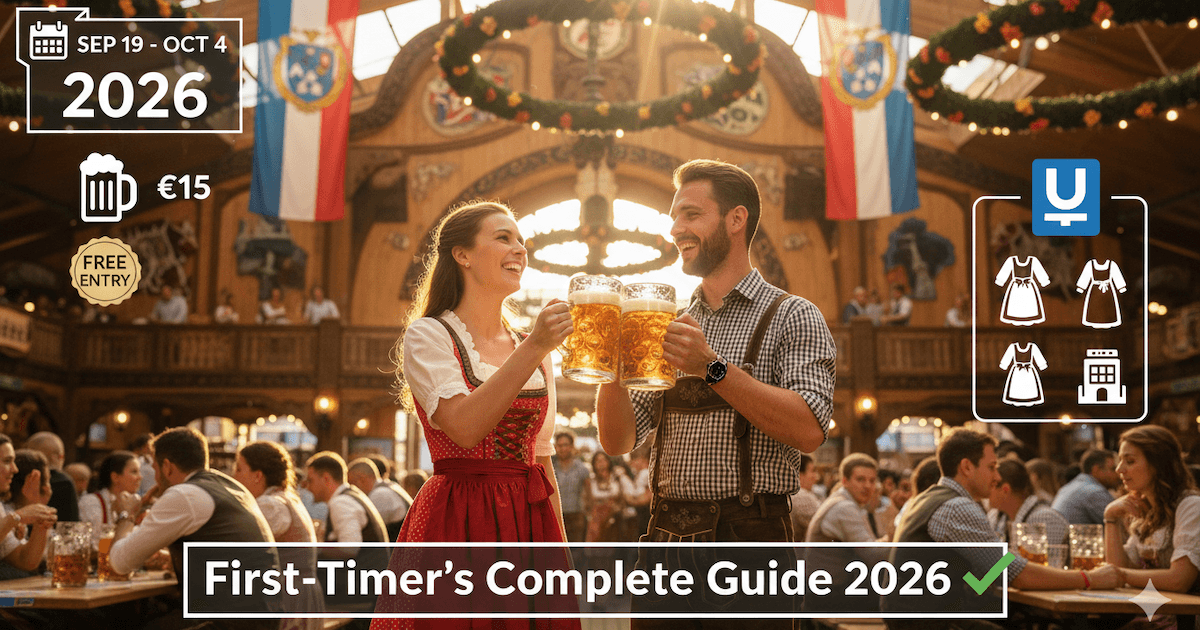
Oktoberfest 2026 is calling, and if you've never experienced the world's largest beer festival, this could be your year. With over 7 million visitors celebrating Bavarian culture, world-class beer, incredible food, and pure festival magic, Oktoberfest is on most travelers' bucket lists for good reason.
But planning your first Oktoberfest trip can feel overwhelming. Questions pile up: When should I go? Where do I stay? How do I get into the tents? What should I bring? This complete guide answers every question a first-timer needs to know to make 2026 your best Oktoberfest yet.
Oktoberfest 2026: The Essentials
Dates: Saturday, September 19 – Sunday, October 4, 2026 (16 days)
Location: Theresienwiese (The Wiesn), Munich, Germany
Hours: Approximately 9 AM – 11:30 PM daily (times vary by day)
Festival Size: 6-7 million visitors, 7+ million liters of beer consumed, 14 large tents, 21 small tents, dozens of rides and attractions
Cost to Enter Oktoberfest: FREE (100% free entry to the festival grounds)
Average Beer Price: Around €15 per liter Mass (1-liter mug)
What You're Celebrating: The 1810 royal wedding of Crown Prince Ludwig and Princess Therese (after which the Theresienwiese is named), and over 200 years of Bavarian tradition and beer culture
Step 1: Book Your Accommodation Immediately
This is non-negotiable: book your hotel now. Seriously. While you're reading this sentence, hotels are booking up for 2026.
Munich has over 80,000 hotel beds, yet during Oktoberfest they're nearly all occupied. Late bookings mean either no availability, hotels an hour outside the city, or prices triple what they were six months earlier.
Where to Stay
Best Location: Close to Theresienwiese (Walking Distance)
Hotels within 0.5 km of Oktoberfest cost more but save transportation time and hassle. Recommended options include Hotel Uhland (5-minute walk), Hotel Mirabell (15-minute walk), and Jedermann Hotel (20-minute walk). Expect to pay €150-300+ per night during Oktoberfest for basic 3-star hotels.
Budget Option: U4/U5 Line Hotels (30 minutes away)
Stay 2-3 U-Bahn stops away on the U4 or U5 lines. You'll save 30-50% on accommodation and have a quick, direct connection to Theresienwiese. Hotels in neighborhoods like Neuperlach or Schwabing cost €70-120 per night and access the festival in minutes.
Ultra-Budget: Camping or Hostels
Stoke Travel operates the most famous Oktoberfest campsite, with camping packages starting at €65 per night including tent, sleeping bag, breakfast, and dinner. Hostels run €40-80 per night. Both work, but expect less privacy and more chaos.
Booking Platforms
Use Booking.com, Hotels.com, or directly book through hotel websites. Many hotels offer Oktoberfest-specific packages including tent reservations, airport transfers, and guided tours. These packages cost more but eliminate planning stress.
Step 2: Choose Your Dates Wisely
The Golden Rule: Skip weekends (especially opening weekend September 19-21).
Friday evenings, Saturdays, and Sundays are absolute madness. Tents reach capacity and close their doors by mid-afternoon. If you must visit weekends, arrive before 9 AM and plan on standing in lines or crowds for most of the day.
Best Days to Visit
Weekdays (Monday-Friday September 23-27 and September 30-October 2): This is your sweet spot. Crowds are manageable, finding tent seats is easy, and the atmosphere remains festive without feeling like a human sardine can. Seriously consider taking time off work for a weekday Oktoberfest visit.
First Sunday (September 21): The Grand Entry parade (Trachten- und Schützenzug) makes this a special day. Historic costumes, floats, and festivities create an incredible atmosphere—but expect massive crowds.
Opening Day (Saturday, September 19): The ceremonial beer tapping in the Schottenhamel tent is the festival's most iconic moment. "O'zapft is!" (It's tapped!) signals the beginning. This day is legendary but impossibly crowded.
Closing Day (Sunday, October 4): The final closing ceremony features a intimate candle-lit gathering in the Hacker-Pschorr tent with 10,000 of your new best friends. Beautiful and memorable—if you can get in.
Family Days (Tuesdays): Rides and menus offer discounts. Perfect for families but also attracts midweek visitors looking for deals.
Length of Stay
First-timers often underestimate how exhausting Oktoberfest can be. A 3-day visit gives you time to experience multiple tents, recover with a day exploring Munich, and not completely destroy your body. A 4-5 day visit allows for more flexibility and a recovery day.
Going for the entire 16 days is excessive unless you're there for the social experience. Most people have maximum fun in 3-5 days before the novelty and physical toll catches up.
Step 3: Understand Tent Reservations vs Walk-Ins
This causes more anxiety for first-timers than it deserves. Here's the truth: you don't need a reservation to experience Oktoberfest tents.
Munich law requires large tents to keep 25% of seating unreserved on weekdays and 40-50% unreserved on weekend mornings. This translates to thousands of available seats every day.
Making Reservations
If you want guaranteed seating (especially for groups of 6+), book directly through the tent operators' websites. Reservation prices typically range from €45-75 per person, which secures your spot and includes a place at the table—drinks and food are extra.
Each tent manages reservations differently. The Hofbräu operates a modern online system, while others use more traditional email-based booking. Research your preferred tent's website for reservation details.
Going Without Reservations
For groups of 1-4 people visiting on weekdays between 10 AM and 3 PM, finding unreserved seats is genuinely easy. Just walk in, tell staff your group size, and they'll seat you within 10-15 minutes.
For larger groups or evening/weekend visits, it gets trickier. But you can still make it happen by:
- Arriving extremely early (before 9 AM on weekends)
- Visiting multiple tents until you find openings
- Checking beer gardens (outdoor seating is less full than indoor areas)
- Trying smaller tents where crowds disperse more evenly
- Using the Oide Wiesn section, which guarantees 33% unreserved seating
Step 4: Plan Your Tent Experiences
With 14 large and 21 small tents, you won't visit them all. Pick 2-3 that match your vibe.
Must-Visit Large Tents
Hofbräu Festzelt: The most iconic, seating 10,000+. First-timers usually visit here. Go early or expect to stand. Includes a standing-room-only area (Stehbereich) for nearly 1,000 people—your backup plan when seated areas fill.
Augustiner Festzelt: Known as the most family-friendly large tent with the best beer (straight from the source). Less rowdy than Hofbräu, more authentic Bavarian atmosphere.
Löwenbräu Tent: Famous for the enormous mechanical roaring lion on top. Fun, energetic, with a good mix of tourists and locals.
Paulaner Festzelt: More sophisticated than some others, with excellent Paulaner beer and family areas.
Worth Exploring: Small Tents
Fischer-Vroni: Known for exceptional fish dishes and a more local, intimate atmosphere. Harder to get into (mostly locals with annual reservations) but worth attempting.
Café Kaiserschmarrn: Perfect for a break from the party tents. Serves Kaiserschmarrn (sweet pancakes), cakes, and coffee. Cozy and family-friendly.
Fisch-Bäda: Specializes in fresh fish and seafood. Small, atmospheric, and easier to access than large tents without reservations.
Münchner Knödelei: Serves traditional Bavarian dumplings in every variation. Vegetarian-friendly and characteristically local.
The Oide Wiesn Strategy
The Oide Wiesn (Old Oktoberfest) section charges €4 entrance but offers guaranteed access with mandatory unreserved seating. Festzelt Tradition in the Oide Wiesn features traditional music, folk dancers, and whipcrackers—authentic Bavarian culture without the chaos. This is your reliability option if other tents are full.
Step 5: Budget Your Money
Entry to festival grounds: €0
Beer (Mass/liter): €14-16
Food (meal): €12-35
Rides: €3-8 each
Sample Daily Budget per Person: €60-100 (covers 3-4 beers, one meal, tips, miscellaneous)
Pro Budget Tips:
- Bring exclusively cash—some vendors don't accept cards, and ATMs charge €3-5 fees
- Tip €1-2 per beer (let servers keep change)
- Tip bathroom attendants €0.50-1 every visit
- Eat before arriving at tents (food is cheaper in surrounding areas)
- Share meals—Oktoberfest portions are enormous
- Skip the rides unless you specifically want them (they're not essential to the experience)
Step 6: Prepare Your Packing List
Essential:
- Valid passport or ID
- Cash (lots of it)
- Phone charger + portable battery
- Comfortable walking shoes (you'll walk 10+ km daily)
- Layers (September weather in Bavaria: 10-20°C/50-68°F mornings, warmer afternoons)
- Small bag (max 20x15x10 cm due to security restrictions)
Highly Recommended:
- Dirndl (women) or Lederhosen (men)—not required but you'll feel the festival more fully
- Light jacket or cardigan for evenings
- Sunscreen and hat for sunny afternoons
- Blister treatment and pain relief
- Deodorant and basic toiletries
Not Allowed:
- Large bags (over 3 liters)
- Weapons or sharp objects
- Recording equipment without permission
- Outside alcohol (though you can bring snacks into beer gardens)
Step 7: Know the Unwritten Rules
At the Tents:
- Never dance on tables—only on benches
- Clink the base of your glass on the table while saying "Prost!"—never clink glass-to-glass (can shatter)
- Don't try to steal beer mugs (security catches hundreds every year)
- If you sit, commit to staying. Servers prioritize seated guests over standing drinkers
- Respect reserved sections—reserved means reserved
- Tipping is not optional; it's how servers survive
In the Beer Gardens:
- You can bring outside food but not outside alcohol
- Tables are first-come, first-served unless marked as reserved
- Leaving your jacket or bag on a bench "saves" it temporarily, but don't abuse this
- Standing room is common—expect to stand if you arrive late
General Festival Behavior:
- Pace your drinking—this is a marathon, not a sprint
- Alternate beers with water to stay hydrated
- Eat substantial food, not just snacks
- Don't trash-talk other nationalities (Oktoberfest is international)
- Be kind to service staff—they're working incredibly hard
Step 8: Plan Your Transport
Public Transport: Best option. U-Bahn lines U4 and U5 go directly to Theresienwiese. Schwanthalerhöhe station (U4/U5) is one stop away and less crowded than the main station.
S-Bahn from Airport: S1 or S8 lines take you directly to Hackerbrücke station (10-minute walk to festival).
Walking: From central Munich hotels, it's possible to walk to the festival in 10-30 minutes.
Never: Drive or plan to drive home. Munich police actively enforce drunk-driving laws during Oktoberfest.
Step 9: What to Expect (The Reality)
The Good:
- Genuine Bavarian hospitality and friendliness
- Life-changing conversations with strangers from around the world
- The most exceptional beer you've ever tasted
- Music, dancing, and pure joy that's contagious
- Incredible traditional food
- Memories that last a lifetime
The Challenging:
- Crowds (7 million people in one place)
- Mud on the Theresienwiese (especially later in September)
- Bathroom lines (can be 15-30 minutes)
- Physical exhaustion (you're drinking, eating, and standing for hours)
- Drunken chaos, especially late at night
- Hangovers that feel like medieval torture
Physical Toll: Your body will hurt. Feet blister from standing. Your liver will work overtime. Hangovers hit different at Oktoberfest. Plan recovery time into your schedule.
Step 10: Pro Tips for First-Timers
-
Arrive before 10 AM on weekdays: This is the difference between a great experience and a frustrating one.
-
Wear comfortable shoes: Seriously. You will regret ignoring this.
-
Make friends immediately: Oktoberfest's magic is in the community. Chat with your table mates. Strangers become best friends by evening.
-
Learn key German phrases:
- "Prost!" (cheers)
- "Ein Maß, bitte" (one beer, please)
- "Danke schön" (thank you)
- "Entschuldigung" (excuse me)
-
Take photos but also experience it: Put the phone down and be present for moments.
-
Try different tents: Don't camp at one tent all day. Visit 2-3 different ones.
-
Explore the food: Hendl (chicken), Schweinshaxe (pork knuckle), Kaiserschmarrn (sweet pancakes), and Leberkäse (Bavarian meatloaf) are all worth trying.
-
Embrace the tradition: Wear dirndl or lederhosen. Dance. Sing along to songs you don't understand. Yodel (badly). Oktoberfest is about surrendering to joy.
-
Plan recovery days: If staying 4+ days, plan a day in Munich exploring the Altstadt, museums, or beer gardens instead of Wiesn.
-
Have a backup plan: If your preferred tent is full, know which alternatives you'll try instead of getting frustrated.
The Bottom Line
Your first Oktoberfest in 2026 will be incredible if you prepare properly. Book accommodation immediately. Choose weekday dates if possible. Don't stress about reservations—the festival welcomes walk-ins. Pack smart, pace your drinking, and be ready for the most joyful, chaotic, exhausting, life-changing festival experience imaginable.
Seven million people will be there. Make sure you're one of them—and do it right.
Prost!